
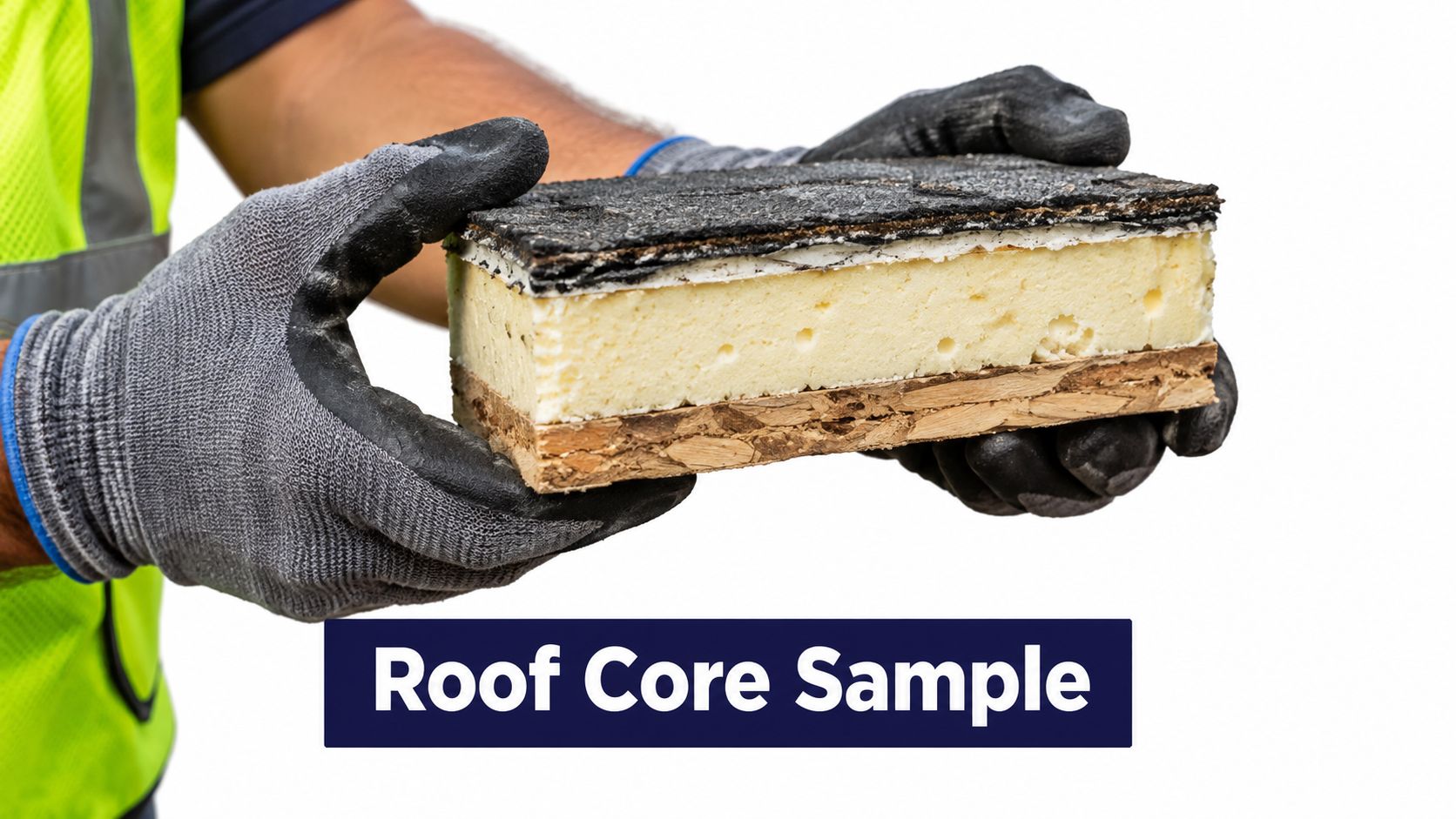
A Phoenix property manager can get a roof report that looks decisive on paper, then still be left with the wrong question. If infrared scanning suggests wet insulation or an aging assembly, a roof core sample is the step that shows what's inside the roof before anyone commits to a repair, recover, or tear-off.
On Arizona low-slope roofs, that matters because heat, UV, monsoon water, and years of patching can hide layer changes that surface inspection won't confirm. A core cut gives the owner a physical cross-section, not a guess.
What Is a Roof Core Sample
A commercial roof can look simple from the ground and still be built from several hidden layers. That's why a manager in Phoenix who gets a replacement recommendation based only on infrared data often asks for a core before approving major work. A roof core sample is the physical answer to that uncertainty, a small specimen removed through the membrane and roofing layers, sometimes reaching into the deck, so the assembly can be verified layer by layer.
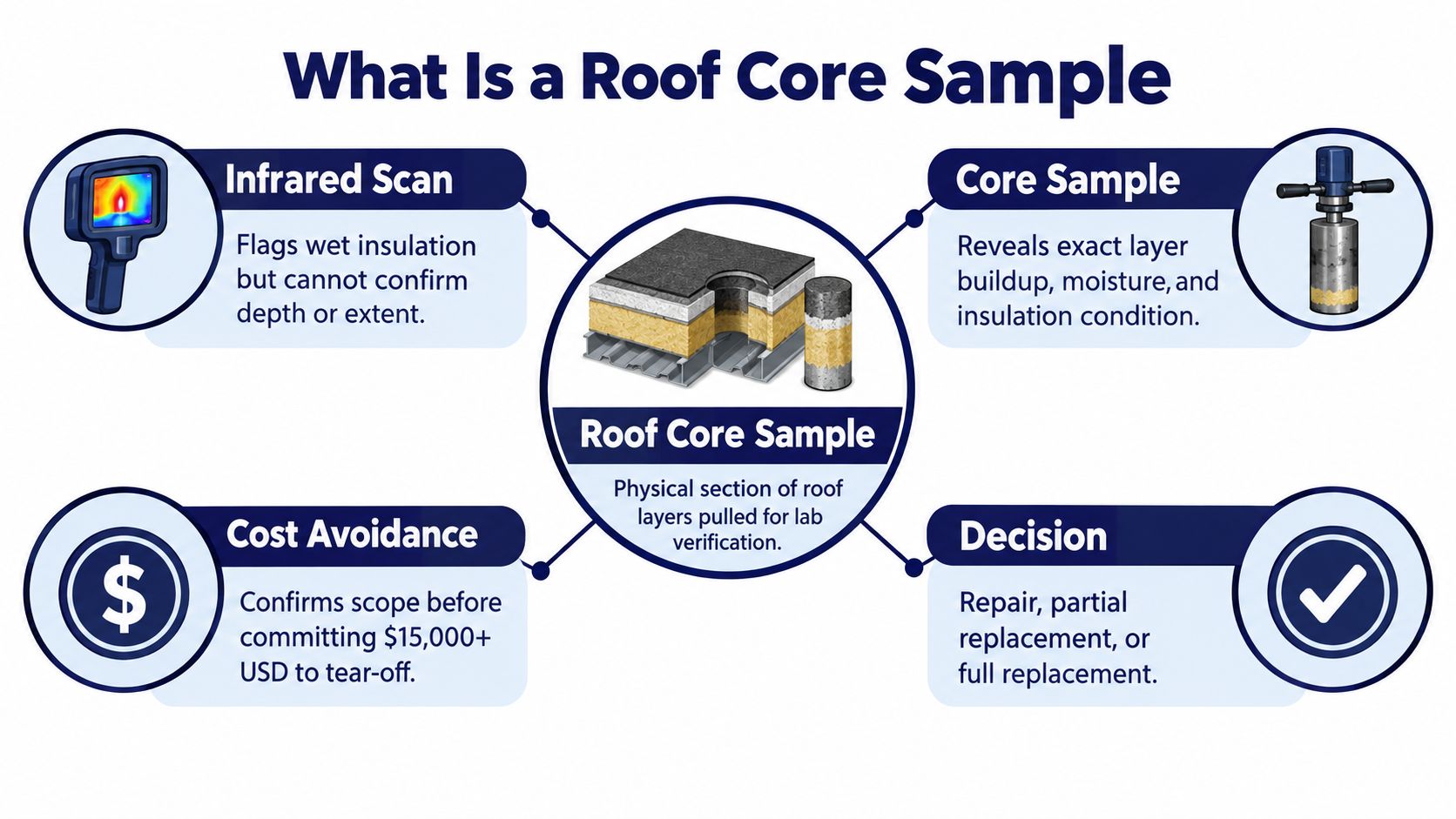
A cut that shows what surface inspection cannot
Visual inspection can confirm obvious damage, open seams, or failed flashing, but it can't tell a building owner how many layers were added over time, whether the insulation has collapsed, or whether moisture is sitting below the surface. ASTM D2829 formalized this kind of investigative sampling for existing built-up roofing systems, and its scope is inspection of existing roofs, not new-construction verification. The point is to estimate what's inside the roof, not to treat one opening as a complete map of the whole assembly. America Roofing's roof guide is useful background on roof parts and how they fit together, but a core goes further because it exposes the actual build-up.
For Arizona owners, that difference matters on flat and low-slope roofs where prior repairs, coatings, or recover attempts can hide the original structure. A core can confirm the approximate composition and arrangement of built-up materials, which is exactly what visual inspection alone can miss. It's a diagnosis tool, not a cosmetic check.
Practical rule: if the roof report jumps straight from “wet area found” to “replace the whole roof,” a core is often the evidence check that keeps the decision honest.
What a Core Sample Reveals About Your Roof Assembly
A core sample is useful because it separates the roof into parts that can be studied independently. That means membrane, cover board, insulation, vapor retarder, base sheet, and deck material can each be examined rather than lumped together as “the roof.” On Arizona commercial roofs, that layer-by-layer view is often what separates a targeted repair from a costly premature reroof.
The assembly story is the real value
The sample can show the approximate thickness and arrangement of the assembly, which is especially important when older roofs have been overlaid more than once. It can also show whether insulation is compressed, degraded, or inconsistent across the sampled area. That's the kind of hidden condition that changes the repair plan even when the top surface still looks serviceable.
Moisture is another key finding, but it has to be measured, not guessed. In documented roof-moisture surveys, samples were weighed, oven-dried, and weighed again so moisture could be calculated by dry weight, which turns a field cut into physical evidence instead of opinion. ASTM D2829 describes the result as approximate, so the best use of the data is alongside field observations, moisture testing, drawings, and lab work, not as a standalone verdict.
A single core can prove what's inside one spot. It can't prove the entire roof behaves the same way.
That's why sample placement matters. Cores should be taken from representative locations, not just the most dramatic scan anomaly or the most convenient walking path. For owners who are trying to understand whether a roof is holding water or just showing surface distress, Marion County homeowners' roof leak guide is a reminder that leaks often begin at details and move into hidden layers long before the roof surface tells the whole story.
A commercial manager comparing results should also look at signs of trapped moisture in TPO when the assembly includes single-ply membrane work, because trapped moisture often changes the recovery conversation more than the membrane itself.
How the Sampling Process Works
A core cut is destructive testing, so it belongs in the hands of a qualified roofing professional, not building staff. The cutter passes through the membrane and roofing layers and is positioned so the deck isn't unintentionally damaged. Sampling is usually best on a flat area that isn't subject to ponding, because standing water can distort what the cut is meant to prove.
What happens during a proper core visit
A competent crew treats the sample location like a controlled field test, not a random hole in the roof. The roof should be accessed safely, with fall protection in place, and the work timed around weather so rain isn't about to hit an open opening. OSHA fall-protection guidance sets the safety boundary here, and on Arizona roofs that boundary matters because heat, glare, and wind can make a quick job less safe than it looks.
After extraction, the hole needs to be restored correctly. Industry guidance calls for filling it about three-quarters full with compatible cold roof mastic, fitting an insulation plug, and covering it with a centered 6-inch disk of 15-pound roofing felt. If that patch is sloppy, monsoon rain can turn a diagnostic opening into a new leak.
A proper visit also includes documentation:
- Photographs of the exact core location, so the opening can be tied back to the inspection report.
- Coordinates or marked roof references, so future inspections can find the same spot.
- Moisture-tight labeled containers, used to keep each sample layer separate for analysis.
- Layer-by-layer notes, so the membrane, insulation, vapor retarder, and deck findings don't get blurred together.
roof inspection in Arizona should be scheduled when the building owner wants the cut documented the right way, especially on commercial roofs where a small mistake can become a water problem fast.
How Core Results Guide Repair vs Reroof Decisions
The value of a core sample shows up when the owner has to decide what to do next. A scan can point to a problem area, but a core helps show whether the roof still has usable structure, whether moisture is limited, or whether the assembly has crossed into replacement territory. For Arizona owners, that can mean the difference between a coating plan, a recover, or a full tear-off.
| Core finding | What it usually means for planning |
|---|---|
| Dry insulation, intact layers | The roof may still support repair, coating, or a recover option if the assembly and deck are otherwise compatible. |
| Wet insulation | The roof likely needs targeted replacement in the affected area, or broader work if the moisture pattern is widespread. |
| Multiple roof layers | Tear-off becomes more likely because old overlays can complicate weight, drainage, and future leak tracing. |
| Unknown deck condition | More testing may be needed before anyone can trust adhesion, fastening, or recovery performance. |
| Incompatible assemblies | Full replacement is often the cleaner path when existing layers won't work with the proposed system. |
Why the roof type changes the decision
A flat roof in Phoenix that has been baked by UV and heat doesn't behave the same way as a foam roof or a roof with a different deck type. That's why a core is best treated as part of a decision chain, not the final word. A dry-looking roof can still have hidden assembly issues, and an aging roof with patchwork repairs can still be sound enough for limited work if the layers are intact.
Decision point: the core doesn't just tell a manager whether there's moisture, it shows whether the roof can realistically be repaired, recovered, coated, or should be replaced.
When the results are borderline, the owner should compare the core findings with leak history, drainage conditions, and the planned service life of the building. America Roofing's Arizona roof repair guide is the right kind of reference point when the question is whether a partial approach is still practical.
What a Core Sample Cannot Prove
A core can be decisive, but it can also be over-read. One opening in a large low-slope roof cannot represent every square foot, and a scanner reading alone only compares one area against another. That's why the best roofing decisions use the core as verification, not as a substitute for the full inspection process.
The limits matter as much as the findings
A core answers questions about assembly makeup and moisture in the sampled area. It does not automatically answer whether an entire concrete deck is ready for new membrane, adhesive, or coating work. NRCA material points to ASTM F2170 in-situ probes for concrete-deck dryness, which matters because a deck can look dry at the surface while still retaining moisture below.
That distinction matters in Arizona, where intense heat can make the top of a roof seem ready long before deeper materials are. A “dry” core doesn't prove a concrete deck is ready for a new system, and it doesn't prove the entire roof behaves the same way. It only proves what the sample showed at the sampled location.
The practical takeaway is simple:
- Use scanning to map likely wet zones.
- Use core cuts to verify what those readings mean.
- Use deck-specific testing when concrete or other moisture-sensitive substrates are part of the decision.
Preparing for a Core Sample Inspection
Good core sampling starts before anyone steps onto the roof. The owner or manager should authorize the destructive test in writing, and the contractor should help pick test points that reflect actual roof conditions, not just convenient spots. Representative locations usually include areas flagged by scanning and a cleaner control area, because one sample by itself doesn't tell the full story.
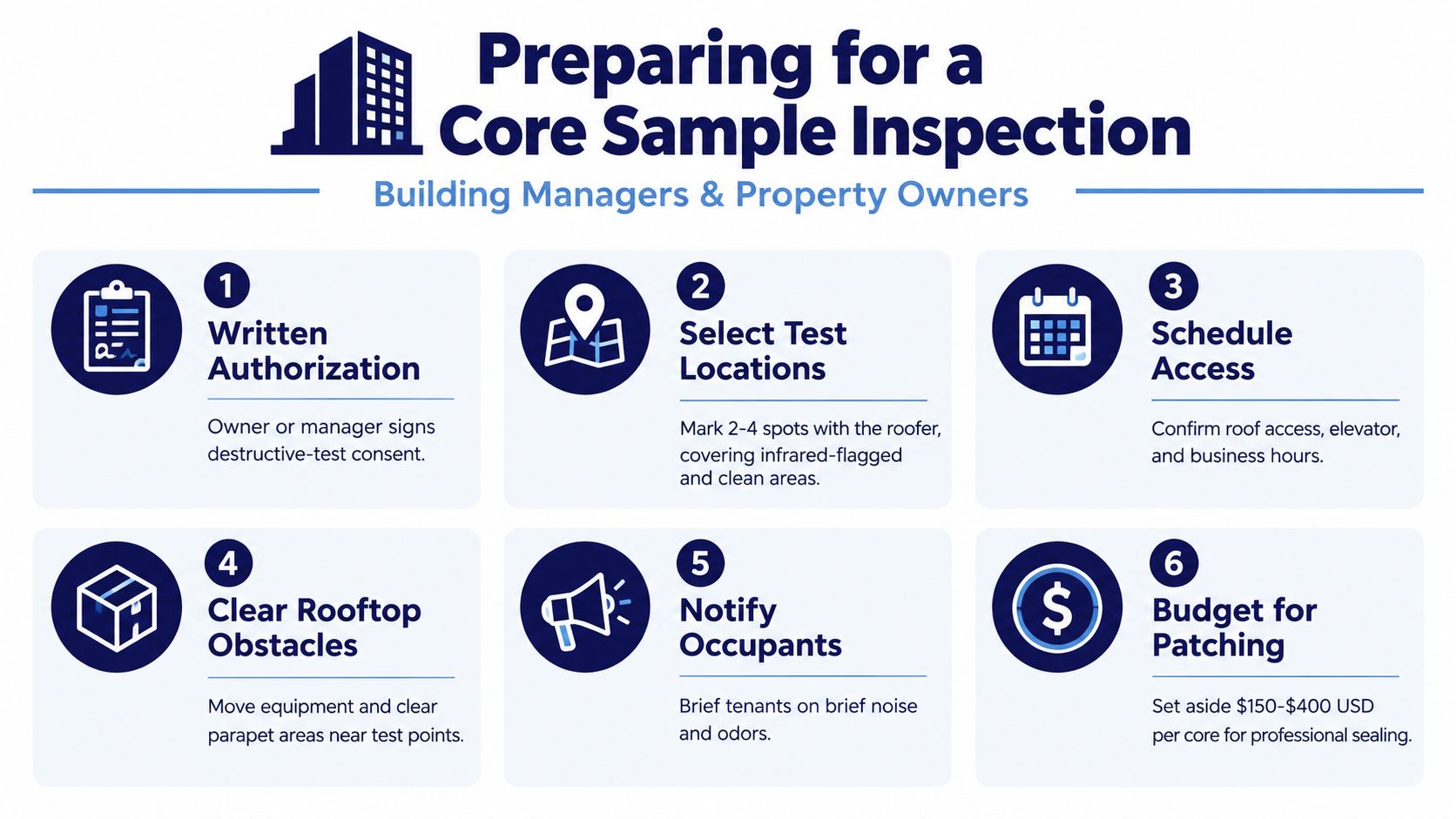
A preauthorization checklist that keeps the job clean
Before the crew arrives, the building manager should make sure these items are settled:
- Written authorization so the destructive cut is approved by the owner or decision-maker.
- Test locations that are marked with the contractor and tied to suspected wet or questionable roof areas.
- Weather timing that avoids imminent rain and allows patch materials to cure properly.
- Roof access that's clear of obstacles, stored equipment, and locked areas.
- Occupant notification if the roof work may create brief noise, odors, or access limitations.
- Written findings and photographs so the owner gets a usable record, not just a verbal summary.
The deck type, roof age, and likely repair path should all be discussed before the cut is made. That's especially important in Phoenix and Tucson commercial work, where the wrong patch or unrecorded opening can create a leak during monsoon weather. Core cuts are not a DIY task, and they should never be treated as a staff maintenance item.
For property owners comparing inspection options, it can help to compare free roof assessments before committing to a larger scope. Owners who want one contractor to evaluate the roof and explain the findings in practical terms can also use America Roofing's commercial roof inspection services in Arizona as the next step when the core results need to be turned into a repair or reroof plan.
A roof core sample is worth doing when the roof's layers, moisture condition, or deck type are unclear and the owner needs a decision that holds up in the field. For Phoenix and Tucson commercial roofs, America Roofing can inspect the assembly, document the findings, and help turn a core result into a repair, recover, coating, or replacement plan that fits the building. Call 602-237-2478 or request a roofing estimate to get the roof evaluated before a small question turns into a costly wrong turn.