
A Phoenix property manager walks onto a commercial roof after a monsoon storm expecting windblown dust and a few scuffs. Instead, a soft area appears near a curb, while a Tucson warehouse reports a stained ceiling tile several rooms away from the actual leak path. These are common starting points when investigating signs of wet insulation under a TPO roof.
What Phoenix and Tucson Building Managers Notice First
The first warning usually arrives inside the building. A ceiling tile may show a brown ring, a tenant may report a musty odor, or an intermittent drip may appear after a storm and disappear before the next work order is filed. Some managers also notice unusual comfort complaints or changes in energy use, but those symptoms don't identify the roof problem by themselves.
A Phoenix or Tucson building can look dry from the occupied space while moisture sits above the ceiling. TPO covers the insulation and roof deck, so soaked polyisocyanurate or another insulation board can remain concealed until the assembly becomes soft, the deck deteriorates, or water finally reaches an interior finish.
Practical rule: The location of an interior stain identifies where water became visible, not necessarily where it entered the roof.
The roof walk should focus on TPO seams, penetrations, curbs, drains, edge details, prior patches, and ponding areas. Open or poorly welded seams, punctures, localized softness, recurring leaks, and thermal anomalies all justify further evaluation, but none proves the full moisture boundary alone. A commercial roofing inspection can help distinguish a maintenance issue from a concealed assembly problem. America Roofing's guidance on TPO roofing Arizona also places the roof assembly, not just the visible membrane, at the center of the inspection.
What Wet Insulation Under a TPO Roof Actually Means
Wet insulation means water has entered the roof assembly and remains within or around insulation boards beneath the TPO sheet. A typical low-slope assembly may include a TPO membrane, hot-air-welded seams, a cover board, one or more insulation layers, and a steel or concrete deck.
The membrane can look clean while the layers below hold moisture. Water commonly enters through a failed seam, pipe boot, curb, termination detail, drain, edge condition, puncture, or an older repair perimeter. Once it gets below the membrane, it can migrate sideways through board joints, along the deck, or around mechanical fasteners before it produces an interior symptom.
A welded seam reduces one route for water entry, but it doesn't make the whole roof assembly watertight forever. TPO membranes entered the market in the mid-1980s and were commercially introduced in the early 1990s. ASTM work on a dedicated TPO specification began in 1993, and ASTM D6878 was finalized in 2003. That standard addresses membrane characteristics, but it doesn't remove the risk created by failed details or defects elsewhere in the assembly.
Water can reduce the insulation's intended thermal performance and contribute to deterioration of cover boards, fasteners, adhesives, and decks. The exact effect depends on the roof design and materials, which is why a surface patch can't establish whether the underlying insulation is suitable to retain. A plain-language overview of TPO roof benefits explained should always be read alongside an assembly-level inspection when moisture is suspected.
A Symptom, Test, and Scope Table for TPO Roofs
Owners and managers need three separate answers:
- What can be observed?
- What can a non-destructive survey indicate?
- What can only an opening or core confirm?
The table below keeps those answers separate. Infrared thermography can identify persistent thermal differences after suitable solar heating and cooling conditions. Electrical-impedance, capacitance, or other moisture instruments can identify areas with readings associated with moisture, but roof surface conditions and assembly materials can affect the result. ASTM C1153-23 covers infrared detection of wet insulation above the deck and in contact with the waterproofing membrane, including ground-based and aerial surveys. The standard also treats thermal patterns as indications that require evaluation, not automatic proof.
| Symptom or Indicator | Owner-Level Observation | Non-Destructive Test | Invasive Verification |
|---|---|---|---|
| Interior ceiling stain | A tile, deck, or finish shows discoloration after rain | Trace the likely roof section, then map with appropriately timed infrared or impedance equipment | A core or test cut identifies membrane, insulation, and deck condition |
| Musty odor | Occupants report an odor near a recurring leak area | Compare the roof area above the complaint with adjacent sections using a moisture survey | Open representative locations to check concealed insulation and deck materials |
| Soft underfoot feel | A roof area feels compressible or unusually flexible | Mark the area and compare surrounding readings with impedance or capacitance equipment | A controlled opening determines whether insulation, cover board, or deck is damaged |
| Ponding-area discoloration | Water collects near a drain or a ring remains after drainage | Survey after suitable conditions and map repeated anomalies | Core the suspect area and check the layers below the membrane |
| Seam uplift | A welded seam appears raised, open, or poorly bonded | Visually map the seam and scan surrounding roof sections | Test-cut the detail to determine whether moisture has moved beneath it |
| Fastener back-out | Plates or fasteners appear raised, loose, or displaced | Survey the nearby field and document attachment irregularities | Open the assembly to check fastener engagement, insulation, and deck |
| Edge metal staining | Staining appears at a perimeter, curb, or flashing transition | Inspect adjacent membrane and use a mapped moisture survey | Open the detail to identify the entry route and affected materials |
| Recent monsoon wind event | A leak or soft area appears after wind-driven rain | Record the storm date, inspect drains and details, and survey when the surface is suitable | Confirm representative anomalies with cores or test cuts before defining repairs |
A survey map is useful because it shows whether suspicious areas repeat across adjacent scans or cluster around a detail. It doesn't establish the exact amount of wet material or prove that every warm or raised reading contains water. Before a repair or replacement scope is finalized, representative areas should be physically verified.
Property managers can schedule a commercial roof check with America when recurring leaks, soft areas, or inconsistent survey results make a visual walk inadequate.
Why No Ceiling Stain Does Not Mean Dry Insulation
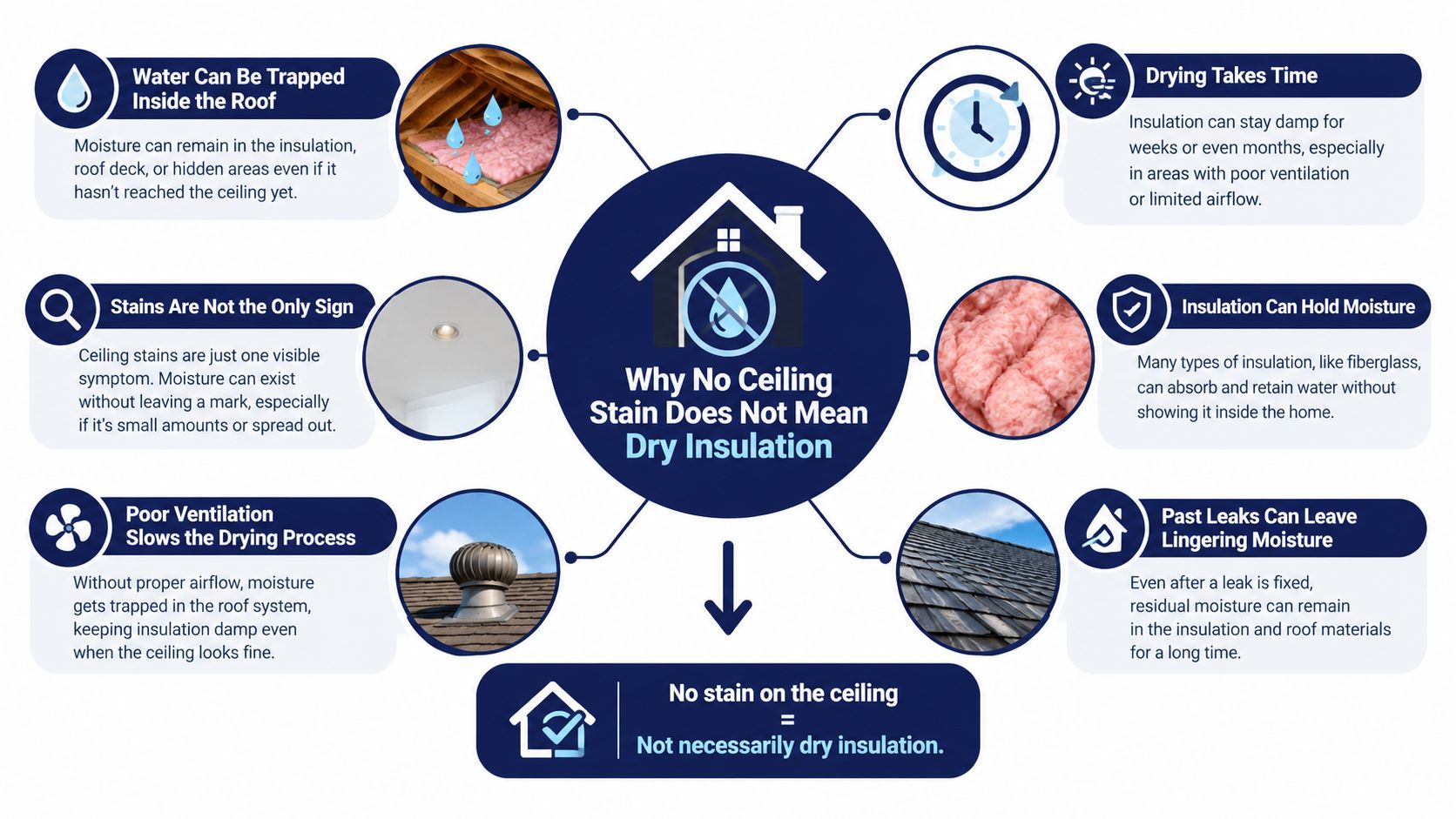
After a monsoon, a warehouse manager may see one ceiling stain and assume the repair is directly above it. That assumption can produce a small patch over a much larger concealed problem. A clean ceiling only shows that water has not become visible at that interior location. It does not prove that the roof assembly is dry.
On a typical Phoenix warehouse deck, moisture can travel 10 to 20 feet or more from the entry point along flute spaces and board joints. The stain location and the appropriate repair boundary therefore rarely coincide. The reverse can also occur. One visible stain may come from a localized defect while nearby insulation remains dry. The interior symptom is a clue, not a scope measurement.
White TPO creates another inspection limitation. Its reflective surface can hide early discoloration, especially under changing sun angles or after the membrane dries. Rooftop equipment, debris, insulation thickness, membrane variations, retained heat, and roof geometry can also produce thermal patterns that resemble wet insulation. A thermal anomaly supports further investigation. It does not establish a demolition boundary.
Why surface patches sometimes disappoint
A patch can stop entry at a failed seam or penetration while wet insulation remains below the membrane. The roof may still develop soft areas, odor, deck staining, or renewed interior leakage as trapped moisture affects materials beyond the patched detail.
Use the symptom to decide whether testing is warranted, then use the test to define scope. If a suspected entry point has dry surrounding materials and a sound deck, a targeted repair may be reasonable. If a moisture survey shows a broad or irregular area, obtain representative cores or a test cut before approving a surface-only patch. Wet insulation or deck changes the repair boundary to the verified dry edge.
A published infrared inspection example of a 9,000-square-foot TPO roof with polyisocyanurate insulation identified three moisture-damaged areas totaling 3,054 square feet, or 33.9% of the roof area. The sample infrared roof report shows why a mapped survey matters. One stain or bright reading cannot establish the complete repair scope.
Repair-Area Versus Broader-Scope Decisions
Once moisture mapping and physical verification are complete, the repair decision becomes a scope question. The size of the ceiling stain matters less than the confirmed condition of the membrane, insulation, cover board, fasteners, and deck.
The decision tree
Suspected seam or penetration failure
→ Is the surrounding insulation confirmed dry and the deck sound?
→ Yes: A targeted membrane and detail repair may be reasonable.
→ No: Remove affected materials to a verified dry boundary.
Clustered wet boards or repeated leak paths
→ Does moisture extend across a roof section or connect several details?
→ Yes: Section replacement may provide a more durable repair than several isolated patches.
→ No: Selective removal can be considered if the remaining assembly is stable.
Widespread moisture or deteriorated deck
→ Can the existing assembly provide a sound, dry substrate?
→ Yes: A recover or restoration approach may be evaluated against manufacturer requirements and roof conditions.
→ No: Tear-off and replacement down to the affected deck may be necessary.
| Scope | Best When | Typical Wet Coverage | Key Risk If Overused |
|---|---|---|---|
| Targeted patch | One confirmed entry point with dry surrounding materials | Isolated area | Leaves concealed moisture outside the patch |
| Section replacement | Several connected boards or details share a moisture boundary | Clustered area | Creates repeated transition details if the scope is fragmented |
| Full recover | The existing roof is dry, stable, and suitable as a substrate | Limited or verified manageable area | Buries unsuitable materials if testing is incomplete |
| Full tear-off | The deck or broad assembly is deteriorated and cannot support a durable repair | Widespread area | Higher disruption and disposal needs when a narrower scope would have worked |
A repair team shouldn't cover wet insulation just because the membrane still looks serviceable. Manufacturer installation guidance identifies roof cuts as the surest technique for deciding whether existing insulation can remain, while infrared, nuclear, and electrical-capacitance methods serve as indirect indicators. Commercial roof recover vs tear off decisions should follow verified conditions, not the apparent size of interior damage.
Arizona-Specific Causes Behind the Moisture
Phoenix, Tempe, Mesa, Tucson, and Glendale roofs face a combination of intense solar loading, dust, short heavy storms, and drainage problems. Monsoon wind-driven rain can reach aging seams, pipe boots, curbs, flashing transitions, and old repair perimeters. A small entry point can then wet insulation beneath an apparently intact membrane.
Details that deserve close inspection
- Seams and laps: Poorly welded or aging seams can admit water, especially where previous repairs interrupt the original membrane detail.
- Drains and scuppers: Dust, leaves, and roof debris can restrict drainage. Ponding leaves more time for water to test weak details.
- Curbs and pipe boots: HVAC curbs and penetrations move differently from the roof field and need careful flashing inspection.
- Prior repairs: Incompatible sealants, patch materials, or poorly prepared surfaces can create new failure perimeters.
- Attachment points: Raised plates, back-pulled fasteners, and damaged cover boards can signal movement or assembly deterioration.
- Roof geometry: Low areas and compressed insulation can direct water toward a detail that looks intact from a distance.
A roof that has been exposed to years of ultraviolet radiation may show brittle or degraded weld conditions, but age alone doesn't prove a leak. The inspection should connect the visible condition to the moisture map and then to physical verification.
Arizona storm response also requires timing discipline. A roof that is wet, dirty, ponded, or covered with reflective surface material may produce unreliable instrument readings. The survey should document recent monsoon exposure, surface conditions, insulation type, drainage paths, seams, penetrations, and flashing locations before anyone interprets the map.
Documentation, Insurance, and Choosing a Local Contractor
Before remediation begins, the property owner or manager should preserve the evidence. Photographs should show interior stains, ceiling damage, roof details, ponding, soft areas, exposed insulation, and any marked survey zones. A dated leak log should connect each report to rainfall, wind, prior repairs, and the affected building area.
Insurance decisions depend on the policy and the documented cause. A sudden storm-related intrusion may be evaluated differently from long-term maintenance deterioration, so repair invoices, storm dates, inspection notes, and earlier patch records can help establish the timeline. A practical resource on essential insurance claim tips can help organize claim documentation, but the policy and insurer's requirements control.
What a written roofing scope should show
A Phoenix or Tucson commercial roofing contractor should provide more than a recommendation to “patch the leak.” The written report should identify:
- Survey method and limitations: State whether the inspection used infrared, impedance, capacitance, visual review, or another method.
- Verification locations: Show where cores, probes, or test cuts were made and what each opening found.
- Moisture boundaries: Separate confirmed wet materials, suspected areas, and verified dry areas.
- Repair details: Explain the failed entry point, removal limits, replacement materials, membrane integration, and deck treatment.
- Cost controls: Describe how concealed conditions and any scope changes will be documented and approved.
Owners should verify the contractor's current Arizona ROC license, relevant TPO manufacturer qualifications, moisture-survey capability, and experience with comparable commercial assemblies. A documented roof inspection in Arizona should remain an inspection service, not a promise to diagnose conditions that haven't been opened.
America Roofing handles commercial roof inspections, leak repair, TPO repair, flat-roof replacement, and broader reroofing decisions in Phoenix and Tucson. Building owners can visit America Roofing or request a roofing estimate with the leak history, survey findings, and roof records ready for review.